Syllabus
Course Description
This course aims to develop programming skills in R, a powerful statistical programming language. This course assumes some prior familiarity with R and ranges from advanced beginner topics to intermediate topics. It will cover practical data science skills in R that are useful for a career in statistics, epidemiology, or data science, including loading data, data wrangling, visualization, automation, machine learning, and running statistical models. A laptop is required for class to participate in coding exercises.
Credit Hours
3 credit hours.
Learning Objectives
- Understand and utilize R/RStudio, including using Quarto to create reproducible documents of statistical analyses.
- Understand basic data types and data structures in R.
- Familiarize and load data files (Excel, Comma Separated Value files) into R/Rstudio, with tips on formatting.
- Visualize datasets using ggplot2 and understand how to build basic plots using ggplot2 syntax.
- Filter and format data in R for use with various routines.
- Run and Interpret some basic statistics in R.
- Automate repetitive tasks in R, such as loading a folder of files.
If time allows:
- Create nice tables in our R markdown reports with
gt,gtsummary, and/orkableExtra.
Course Website
All course information will be available here:
https://niederhausen.github.io/BSTA_526_W26/
Information will also be available on Sakai.
Office Hours
See Sakai for Webex links to office hours
In addition to times below, office hours can be set up by appointment at other times. Please email whom who would like to set up an office hour with.
Mondays 3:00-4:00 pm with TA Michael Daily
Tuesdays 11-11:50 am with Meike
Prerequisites or Concurrent Enrollment Requirements
- BSTA 511 or permission by instructor.
Instructor Information
Instructor
- Preferred Method of Contact: Email. When emailing, please include BSTA 526 in the subject line.
- Expected Response Time: 1 business day
- Meike Niederhausen, PhD
Teaching Assistant
- Michael Daily
Attendance
- This class will meet in-person and you are expected to attend class regularly. However, I understand that it is not always possible to attend class and daily attendance will not be monitored.
- Classes will be recorded, but I cannot guarantee the in-person format will lend itself to effective recordings. If you miss class, please reach out to a classmate for missed material.
Post-class surveys
- 5% of your grade is based on filling out post-class surveys as a way of indicating that you came to class and engaged with the material for that week.
- You only need to fill out 7 surveys (of the 10 class sessions) for the full 5%.
- I encourage you to fill out as many surveys as possible to provide feedback on the class though.
- Please fill out surveys by the following Wednesday at noon.
- The questions on the survey are:
- Rating the pace of the class
- Clearest Point: Which topic of the class was clearest for you?
- Muddiest Point: Which topic of class was the muddiest (unclear) for you?
- Anything Else: Anything else you’d like me to know?
Homework
- Homework will be assigned weekly using Quarto in RStudio.
- It will be due via Sakai upload Thursdays at 11:55pm the night of the following week’s class (unless otherwise noted).
- Please turn in both your .qmd and rendered .html file.
- The homework with the lowest score will be dropped from your homework average.
Late Policy
- Students get 1 free homework assignment to submit late within 3 days without penalty.
- Please email the instructor and the TA that you need more time.
- If you need an accommodation, please email me so I can figure out a way to help you.
Functions of the Week
- Please choose a function(s) from the Functions of the Week sign-up sheet (link is posted on Sakai.
- A Quarto template to format your Function of the Week and presentation will be provided.
- Functions of the Week presentations will start in week 4.
- On the sign-up sheet you will choose a week to present your function(s) to the class, as well as the function(s).
- The presentation should be short, around 5 minutes.
- If presenting to the class feels prohibitive, you may submit a 5-10 minute screen recording with your voice narrating the presentation, and this will be distributed to the class.
Previous years’ Functions of the Week can be found on the previous class websites:
- https://niederhausen.github.io/BSTA_526_W25/function_week.html
- https://niederhausen.github.io/BSTA_526_W24/function_week.html
- https://sph-r-programming-2023.netlify.app/functions/
- https://sph-r-programming-2022.netlify.app/functions/
- https://sph-r-programming.netlify.app/functions/ (2021)
I will create a similar website for this year’s Functions of the Week. If you do not wish yours to be on the public facing website, just let me know. Alternatively, I can also post it anonymously. See submitted Functions of the Week for this quarter at this link.
Midterm and Final Exams
- Midterm and final exams will be take home.
- The midterm will be a project based on a dataset of your choosing.
- The final will be based on an assigned dataset.
- The midterm will be a project based on a dataset of your choosing.
- Examples of previous years’ midterms can be found on the class websites:
- https://sph-r-programming-2023-midterms.netlify.app/
- https://sph-r-programming-2022-midterms.netlify.app/
- https://sph-midterm-projects.netlify.app/ (2021)
- I will create a similar website for this year’s midterm projects.
- If you do not wish your project to be on the public facing website, just let me know. Alternatively, I can also post it anonymously.
Grading Policy
A weighted average of the grade will be calculated using the assessment weights listed below.
- Attendance (based on post-class surveys) 5%
- Homework Assignments 30%
- Function of the Week 5%
- Midterm Exam 30%
- Final Exam 30%
Please note that the Sakai grade book is not programmed to calculate your final grades. It will list your scores on each individual assessment, but ignore the overall grade it provides.
Grading Scale
- Final grades will be assigned based on cutoffs in the table below.
- When final grades for the quarter are calculated, percentages will be rounded up; for example 89.5% is an A-.
| A | Exceeds the standard |
| B | Meets the standard |
| C | Key gaps in understanding of the standard |
| D | Unable to demonstrate B or C without assistance |
| F | No evidence |
| Letter Grade | Percentage |
|---|---|
| A | ≥93% |
| A- | 90-92% |
| B+ | 88-89% |
| B | 83-87% |
| B- | 80-82% |
| C+ | 78-79% |
| C | 73-77% |
| C- | 70-72% |
| D | 60 – 69% |
| F | <60% |
Code of Conduct
And as students of an OHSU course, we must abide by the OHSU Code of Conduct: https://www.ohsu.edu/integrity-department/code-conduct
This class is meant to be a psychologically safe space where it’s ok to ask questions. We want to normalize your own curiosity and fuel your desire to learn more.
Required Texts and Readings
This course will be drawing on the following online textbooks. These books are online and free, though you can order them as textbooks if you prefer that format.
- R for Data Science. Hadley Wickham, Mine Çetinkaya-Rundel, Garrett Grolemund. 2nd Edition. https://r4ds.hadley.nz/
- Quarto webpage https://quarto.org/
- Getting Used to R, RStudio, and RMarkdown. Chester Ismay. https://ismayc.github.io/rbasics-book/
- Data Science: A First Introduction. Tiffany Timbers, Trevor Campbell, Melissa Lee. https://datasciencebook.ca/
- Advanced R. Hadley Wickham. https://adv-r.hadley.nz/
Note on RMarkdown vs. Quarto
- We will be using the newer Quarto instead of RMarkdown for creating reproducible documents. Some of the links above are for RMarkdown, which is very similar.
- The main differences are in setting up the yaml and code chunk options.
- Many of the RMarkdown code chunk options work with Quarto though.
- With Quarto you will see a
Renderbutton instead of aKnitbutton to create the html output of the file.
Words of Encouragement
This was adopted from Andrew Heiss. Thanks!
I promise you can succeed in this class.
Learning R can be difficult at first—it’s like learning a new language, just like Spanish, French, or Chinese. Hadley Wickham—the chief data scientist at RStudio and the author of some amazing R packages you’ll be using like ggplot2—made this wise observation:
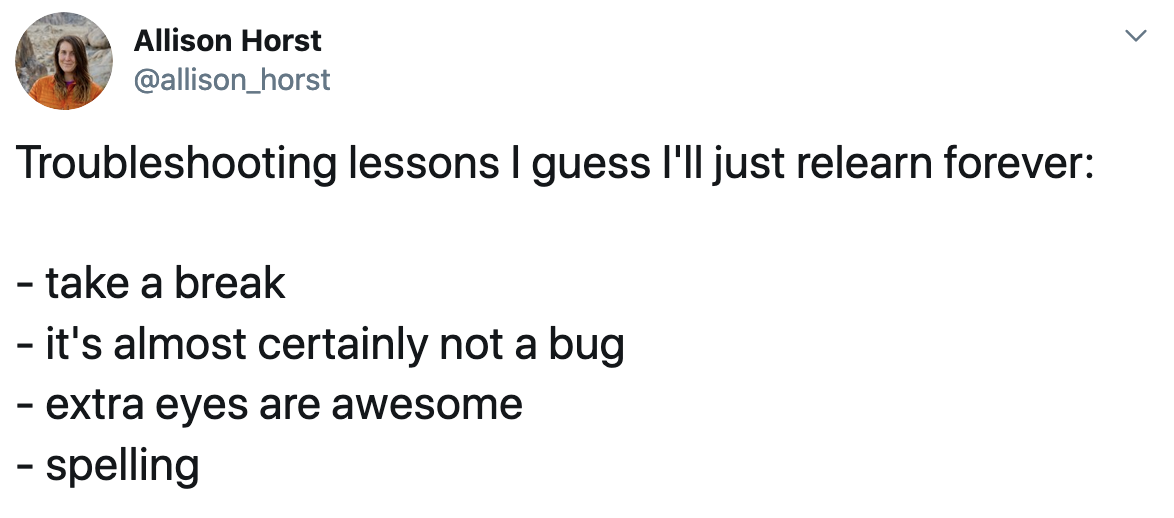
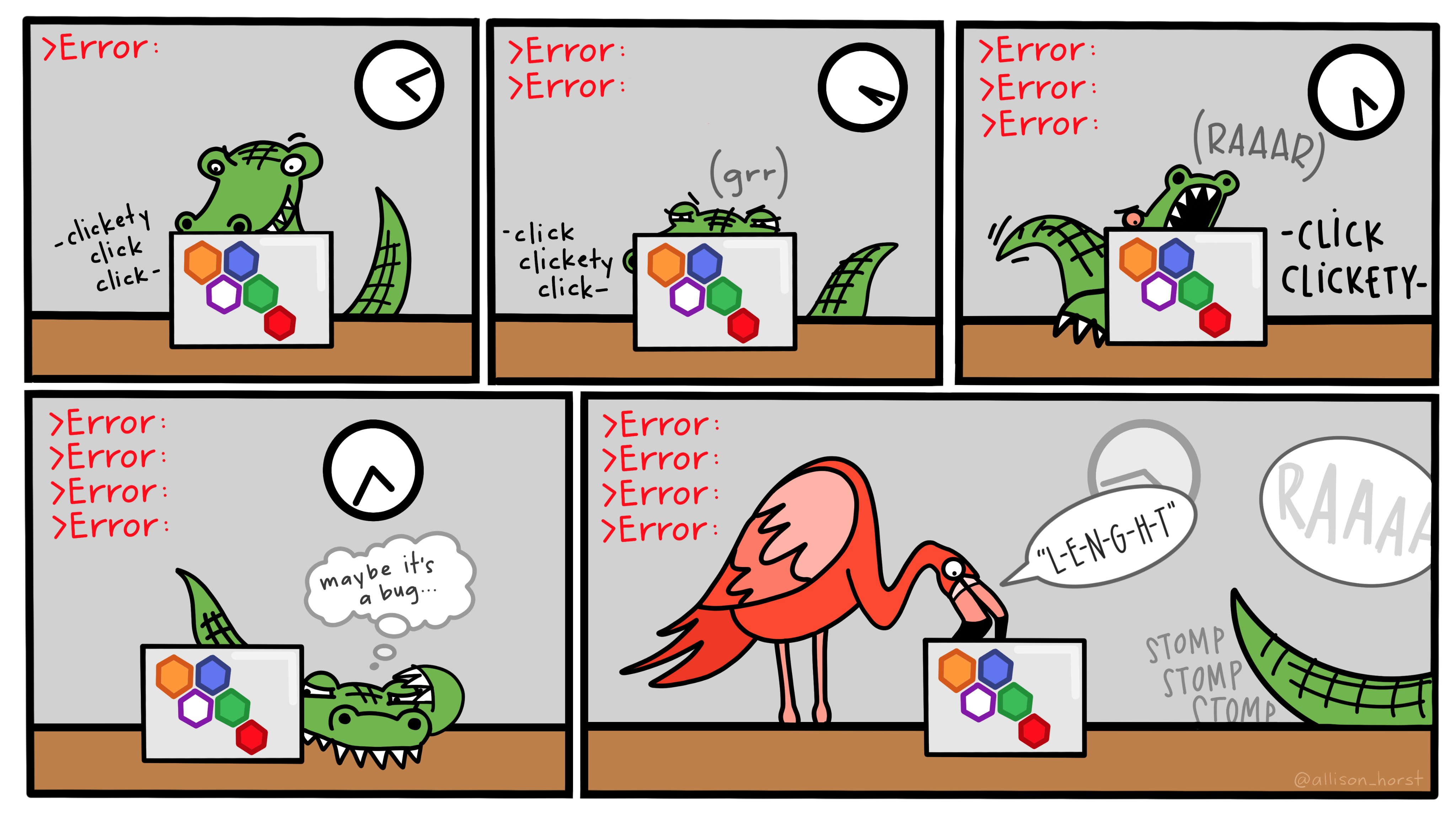
It’s easy when you start out programming to get really frustrated and think, “Oh it’s me, I’m really stupid,” or, “I’m not made out to program.” But, that is absolutely not the case. Everyone gets frustrated. I still get frustrated occasionally when writing R code. It’s just a natural part of programming. So, it happens to everyone and gets less and less over time. Don’t blame yourself. Just take a break, do something fun, and then come back and try again later.
Even experienced programmers find themselves bashing their heads against seemingly intractable errors. If you’re finding yourself taking way too long hitting your head against a wall and not understanding, take a break, talk to classmates, e-mail me, etc.
Copyright Information
Every reasonable effort has been made to protect the copyright requirements of materials used in this course. Class participants are warned not to copy, audio, or videotape in violation of copyright laws.
To comply with the fair use fair use doctrine of the US copyright law, Sakai course sites close three weeks after grades are posted with the Registrar. Please be sure to download all course material you wish to keep before this time as you will have no further access to your courses.
School of Public Health Handbook
All students are responsible for following the policies and expectations outlined in the student handbook for their program of study. Students are responsible for their own academic work and are expected to have read and practice principles of academic honesty, as presented in the handbook: https://ohsu-psu-sph.org/current-graduate-students/policies-procedures/#academic-dishonesty.
Syllabus Changes and Retention
This syllabus is not to be considered a contract between the student and the School of Public Health. It is recognized that changes may be made as the need arises. Students are responsible for keeping a copy of the course syllabus for their records.
Syllabi are considered to be a learning agreement between students and the faculty of record. Information contained in syllabi, other than the minimum requirements, may be subject to change as deemed appropriate by the faculty of record in concurrence with the academic program and the Office of the Provost. Refer to the Course Syllabi Policy, 02-50-050.
Syllabus Statement Regarding Disability Services
OHSU is committed to providing equal access to qualified students who experience a disability in compliance with Section 504 of the Rehabilitation Act of 1973, the Americans with Disabilities Act (ADA) of 1990, and the ADA Amendments Act (ADA-AA) of 2008. If you have a disability or think you may have a disability (physical, sensory, chronic health, psychological or learning) please contact the Office for Student Access at (503) 494-0082 or studentaccess@ohsu.edu to discuss eligibility for academic accommodations. Information is also available at www.ohsu.edu/student-access. Because accommodations may take time to implement and cannot be applied retroactively, it is important to have this discussion as soon as possible. All information regarding a student’s disability is kept in accordance with relevant state and federal laws.
Please see Student Access & Accomodations section for more details on the Sakai version of this Syllabus.
Commitment of Equity and Inclusion
The School of Public Health is committed to providing an environment free of all forms of prohibited discrimination and discriminatory harassment. The School of Public Health students who have questions about an incident related to Title IX are welcome to contact either the OHSU or PSU’s Title IX Coordinator and they will direct you to the appropriate resource or office. Title IX pertains to any form of sex/gender discrimination, discriminatory harassment, sexual harassment or sexual violence.
PSU’s Title IX Coordinator is Julie Caron, she may be reached at titleixccordinator@pdx.edu or 503-725-4410. Julie’s office is located at 1600 SW 4th Ave, In the Richard and Maureen Neuberger Center RMNC - Suite 830.
The OHSU Title IX Coordinator’s may be reached at 503-494-0258 or titleix@ohsu.edu and is located at 2525 SW 3rd St.
Please note that faculty and the Title IX Coordinators will keep the information you disclose private but are not confidential. If you would like to speak with a confidential advocate, who will not disclose the information to a university official without your written consent, you may contact an advocate at PSU or OHSU.
PSU’s confidential advocates are available in Women’s Resource Center (serving all genders) in Smith Student Memorial Union 479. You may schedule an appointment by (503-725-5672) or schedule on line at https://psuwrc.youcanbook.me. For more information about resources at PSU, please see PSU’s Response to Sexual Misconduct website.
OHSU’s advocates are available through the Confidential Advocacy Program (CAP) at 833-495-CAPS (2277) or by email CAPsupport@ohsu.edu, but please note, email is not a secure form of communication. Also visit www.ohsu.edu/CAP.
At OHSU, if you encounter any harassment, or discrimination based on race, color, religion, age, national origin or ancestry, veteran or military status, sex, marital status, pregnancy or parenting status, sexual orientation, gender identity or expression, disability or any other protected status, please contact the Affirmative Action and Equal Opportunity (AAEO) Department at 503- 494-5148 or aaeo@ohsu.edu.
At PSU, you may contact the Office of Equity and Compliance if you experience any form of discrimination or discriminatory harassment as listed above at equityandcompliance@pdx.edu or by calling 503-725-5919.
Academic Honesty
- Course participants are expected to maintain academic honesty in their course work. Participants should refrain from seeking past published solutions to any assignments. Literature and resources (including internet resources and generative AI) employed in fulfilling assignments must be cited.
- See Purdue University’s Online Writing Lab for resources on plagiarism and importantly avoiding plagiarism (thanks to Steve Bedrick for this link!).
- Assignments suspected of plagiarism (including copying past solutions or another student’s assignment) will receive 0 points for the assignment and the dean of the student’s academic program will be notified.
- In an effort to uphold the principles and practice of academic honesty, faculty members at OHSU may use originality checking systems such as Turnitin to compare a student’s submitted work against multiple sources.
- To protect student privacy in this process, it will be necessary to remove all personal information, i.e. student name, email address, student u-number, or any other personal information, from documents BEFORE submission.*
Use of generative AI for assignments
Generative AI tools (such as ChatGPT) can be great resources for learning how to code and/or troubleshoot code that does not work. However, the work you turn in must be your own. Thus it is inappropriate to directly ask AI to provide you with solutions to homework questions or write text that you are submitting in your assignment.
If you do use AI tools to help you with an assignment, these must be cited along with how they were used.
Please see the Plagiarism & Attribution section (Code Snippets and AI Tools subsection) of Dr. Steve Bedrick’s BMI 525: Principles and Practice of DataVisualization webpage for examples of appropriate and inappropriate uses generative AI.
Use of Sakai
Sakai is OHSU’s online course management system. Some course information will only be available on Sakai, and you will be turning in all assignments using Sakai. For any technical questions or if you need help logging in, please contact the Sakai Help Desk. See also the Sakai Student Guide for more information.